

Do You Even Have a Personality?
Personality tests have been wildly successful at one thing: building an industry around themselves.

Most personality assessments are better at selling themselves than explaining you
Their popularity says more about organizational demand for neat categories than about their scientific strength.The right way to use them is like broken rulers
They are not accurate, but they can still be informative in comparison. They work best when placed side by side with others, not when treated as precision tools.Results describe default tendencies, not limits
Traits are patterns of behavior in context, not hard boundaries. Treating them as destiny is a category error, not self-knowledge.Who you are is shaped by who you’re around
Personality shows up in interaction, not in isolation. Change the context and the “type” often changes with it.
Personality tests have been wildly successful at one thing. Building an industry around themselves.
Or at least that is where my roughly hundred leadership students and I landed after a long reflection on what these tools are actually good for.
When it comes to the evidence base behind even the most popular personality assessments, many of them stand on stilts rather than on anything resembling bedrock. Better than horoscopes, sure. Still a long way from anything you would want to bring to a thesis defense.
And yet, me and my colleagues would be asking for trouble if I tried to run a ten-thousand-dollar executive leadership course without handing out at least one assessment.
Myers-Briggs, Belbin, DiSC, and their extended family have become so embedded in organizational life that they have almost become part of the institutional fabric of organizational performance and leadership.
Which is exactly why I need to tell you something: every personality test you have ever taken functions exactly like a broken ruler.
That does not mean it is useless. Instead, it means you need to understand how to use it because even a broken ruler can tell you something, as long as you stop pretending it is a precision instrument.
A brief history of confident nonsense
If you are up to date on your philosophy and logic homework, you know to be suspicious of ad hominems. Indulge me anyway, because the origins of this industry matter more than we like to admit.
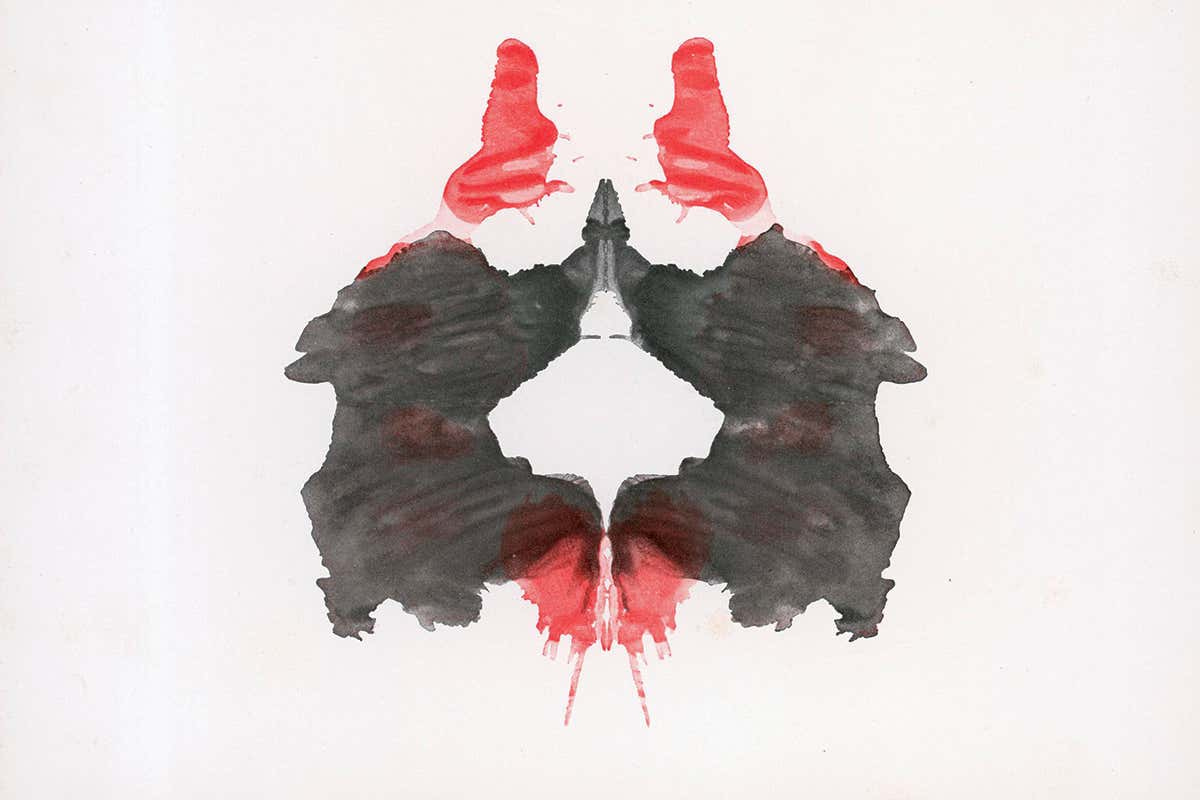
A hundred years ago, state-of-the-art psychological assessment meant Rorschach inkblots and cranial measurements. Both were administered by confident experts, both were treated as cutting-edge science, and both told us far more about the beliefs of their practitioners than about the minds of their subjects.
Today, we file them away under curious things our ancestors believed in, right next to Freud’s insistence that most human suffering could be traced back to what essentially boils down to MILFs.
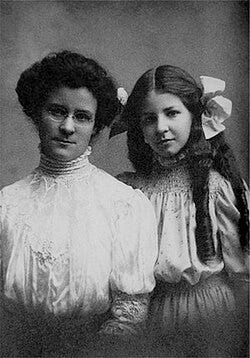
In what was genuinely meant as a helpful intervention, Katherine Briggs and her daughter Isabel Myers built what would later become the Myers-Briggs Type Indicator, drawing heavily on Carl Jung’s theory of psychological types.
In doing so, they launched a billion-dollar industry that almost everyone reading this has encountered in one form or another.
Before this pivot, both women were known primarily for their essays and mystery novels. Neither had formal training in psychology or psychometrics. In almost any other context, I would celebrate the range and the audacity. And to a great extent, I still do because what they accomplished and when they accomplished it, is impressive.
The methods, however, leave a lot to be desired.
Instead of grounding the instrument in rigorous, controlled experimentation, the MBTI emerged from what can politely be called motivated research. Admiration for Jung and the desire for immediate usefulness in a wartime economy took precedence over careful inquiry into what personality actually is and how it operates.
More strikingly, neither Briggs nor Myers, nor the assessment developers who followed, have paused to properly define personality itself before moving on to the far more profitable business of measuring it.
It is therefore no surprise that the case against the MBTI and its relatives has only strengthened over time. Critics have pointed to the arbitrariness of its categories, the weakness of its validity claims, its limited ability to predict anything that actually matters, and its total dependence on self-reporting. Add to that how easily the results can be gamed once you understand what is being asked, and the scientific footing becomes increasingly hard to defend.
Making a strong evidence-based case for most personality assessments today requires a level of prior belief that is hard to defend. The argument only holds if you are already committed to the conclusion, in the same way that claims about Biden’s sharpness or the economic success of Trump’s tariffs depend largely on prior beliefs.
Which is precisely why I do not advocate throwing these tools away.
We just need to treat them as the structured pseudo-science with social utility that they are.
The right way to work with personality assessments
By far the most intellectually engaging part of this week’s class was our attempt to define personality itself.
Personality is one of those concepts that lives comfortably under the banner of “I know it when I see it” where we use it constantly without ever feeling the need to properly map its boundaries.
But pause for a moment to ask yourself what it actually means and you’ll see how lost we truly are when it comes to pinning the concept down.
Some students suggested it is about manners and reactions which is a great place to begin. Walk around smiling and singing and you will quickly earn a reputation as cheerful. Do the opposite and people will label you a grump without hesitation.
Still, our intuitive sense of personality goes much deeper than that.
As the list grew, we added habits, speech patterns, thinking styles, how we treat others, how we treat ourselves and eventually we reached the point where someone suggested we could just say “how we are” and call it a day.
That would have been a grave mistake.
What the room slowly realized is that any attempt to define personality as “how we are” is meaningless if it doesn’t have the follow-up “with and according to others.”
You see, personality is not something we simply possess in fixed quantities and known dimensions. It is something we exhibit, and something that emerges from within us, in social contexts which actively shape what personality ends up showing up.
Take the Big Five framework, often referred to as OCEAN, which rests on far stronger empirical footing than most alternatives as an example and pick any dimension, say agreeableness. Without someone or something to agree or disagree with, the trait collapses into meaningless abstraction. Belbin makes this dependency explicit by anchoring roles directly in team dynamics. DiSC does the same by design, and so on.
Even traits that seem internally contained, such as neuroticism, begin to blur into behavior and situational response once you remove them from lived interactions with others.
Whatever personality you believe you have, it is far more contingent on the people around you than you probably want to admit.
Which is why I have kept a particular saying close to my heart ever since I first heard it. Before you conclude that you are depressed, make sure you are not surrounded by assholes.
And that brings me to the three points about personality tests I want everyone I care about to actually absorb.
First, personality tests work best when we treat them as measurement tools we know to be inaccurate. At best, they are broken rulers.

They do not reveal deep truths, but they can still be informative, especially in comparison. You can establish relative height with a banana almost as effectively as with a tape measure, as long as you stop pretending the banana is precise.
Second, the most intimate parts of who we are are shaped by others far more than we like to believe.
The personalities we claim, and the ones assigned to us, largely emerge from interaction with others, not from immutable inner cores. Yes, default settings exist, but they allow far more range than most assessments suggest.
Finally, who you are today, particularly in the eyes of others, is not a determination of what you can be tomorrow.
What 'bothers me most about how personality tests are typically used is how easily they slide from description into destiny.
They are nothing of the sort.
If you treat a four-letter code (mine is ENTJ) as a full-HD portrait of your inner life, good luck carrying those 2026 resolutions across the finish line.
Real change of the truly transformative kind needs us to see beyond the types and categories and to grant ourselves permission to be greater than we are today. And that requires us to know that whatever personality type we have today, isn’t what we have to carry into tomorrow.
A book to read
Paul Costa & Robert McCrae, Personality in Adulthood
This is the book that quietly dismantles most of what people think they know about personality without ever raising its voice. Costa and McCrae are not interested in types, labels, or dramatic transformations as much as they are interested in patterns that persist, patterns that shift, and the uncomfortable middle ground where both are true at the same time. What makes the book enduring is not that it claims personality is fixed, but that it refuses the fantasy that it is infinitely malleable either. Read it slowly and you start to see adulthood less as a finished state and more as a long negotiation between continuity and change, where neither side ever fully wins.
A thought to have
Non-determinism
We are remarkably eager to box ourselves in. We treat descriptions as if they were borders and scores as if they were verdicts. Non-determinism is the deliberate refusal to do that. It is the choice to hold your traits lightly, to see them as tendencies rather than ceilings. The point is not to deny that patterns exist, because they do, but to resist turning them into fate. Most growth stalls not because people misunderstand who they are, but because they stop granting themselves permission to be more than that.
A thing to do
Use assessments like broken rulers. Compare, but never conclude.
Personality tests can be useful when you treat them as relative instruments rather than precise ones. They can highlight contrasts, tensions, and mismatches, especially between people working together. What they cannot do is tell you who you are in any final sense. The mistake is not using them. The mistake is letting an imprecise tool harden into an identity. Measure differences if you must, but do not confuse measurement with truth.
A product to love
Neuro Gum, sleep version.
This is one of those products that does exactly what it promises without trying to become a lifestyle. No optimization theater, no performance cosplay. Just a clean, reliable way to take the edge off at the end of the day when your mind refuses to stand down on its own. We’ve come back to it more often than expected, which is usually the only endorsement that matters.

Study #1: Seeing if Kvashchev’s experiment holds water.
We’re enrolling up to 200 participants for a lighthearted study on whether creative problem solving actually does a thing to our cognitive performance. Join here!
Study #2: Range as a predictor of leadership success
I am currently conducting a study on range and how it impacts people’s career trajectories. Ten questions and a name will get you on the hall of fame as we pump up the n on the study. Link below - thanks for considering it!

You’ve reached the end - thanks for scrolling all the way down.
Curiosity is best when enjoyed in great company.
Came for the brilliant analysis, stayed for the bears dressed as Santa throwing a bodacious high-five. I'd like to use this comment to put on record that I once used a banana for scale in a photo with a particularly tall Californian redwood, so it does work.
Enjoyable as ever.