

Better than Adderall: Could answering this question raise your IQ by 10 points?
Kvashchev's study and the power of creative problem solving

AI is the new competition in the classroom, and the heat is on
The false promise of Adderall and the limits of IQ
The Kvashchev puzzle that (perhaps?) can raise IQ scores by 10–15 points through creative problem solving.
Rather than dismiss the study, we’re launching a semester-long trial with students at Harvard, Columbia, and NYU Stern, swapping stimulants for weekly problem-solving exercises and seeing what happens. Readers are invited to join the experiment, too.
While every beginning of a semester brings its own brand of chaos, this one feels profoundly different.
The classroom contest is no longer student versus student. Now, there’s a new player on the field, OpenAI (and Claude for the 2% that use it - you artisans!). For today’s students, the benchmark isn’t matching the peer sitting two rows over, it’s competing with the machine that can out-research even the most adept of them in seconds.
Which means they’ll need every edge they can muster if they want to perform at their highest level.
For decades, Adderall has been the go-to shortcut for students chasing sharper focus and faster recall. It delivers short-lived cognitive peaks at a steep cost with crashes that often outweigh the fleeting highs, and a cycle of dependency that isn’t worth even kicking off. It’s a chemical parlor trick, not a path to lasting performance, yet many still reach for it because we as teachers and doctors have offered little else in its place.
In fact, when is the last time anyone taught you, with scientific rigor instead of pseudo-scientific hocus-pocus, how to increase your learning performance?
One reason I suspect many of you will answer never is because IQ itself has always been a slippery idea. It’s hard to define, even harder to measure, and once we do measure it, it is famously resistant to moving at our own behest.
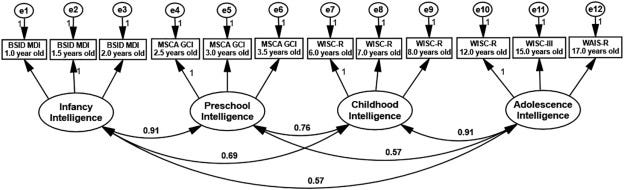
Decades of research have found intelligence to remain stable from early childhood to adulthood have hammered home the conclusion of intelligence as a fixed quantity. Unsurprisingly, many walk away with the belief that their mental horsepower is predetermined and untouchable.
I’ve pushed back against that for years, and I’ve only become more vocal about it.
Even if it’s true that we can’t push our raw IQ one way or another, we have a much more useful concept at hand in what I call effective IQ, or how well we use the abilities we have. Framed this way, intelligence becomes less of a static score that we’re endowed with and more of a dynamic process to tend to.
And suddenly, our habits matter deeply. Sleep, focus, reflection, even the way we structure our thinking can lead to meaningful improvements in our output capacity. Small shifts compound into outsized gains, and the Adderall prescription becomes even more self-defeating.
But then I stumbled across a study that unsettled me by arguing that our raw IQ itself could be pushed upwards.
In 1980, a researcher named Kvashchev conducted a three-year study on nearly 300 students in two Serbian schools. Entire classes were randomly assigned to different approaches, and the reported results were nothing short of dramatic with IQ increases of a whopping 10 to 15 points. Four decades later, Lee and Stankov reviewed the work and drew attention to just how striking the findings were.
Could such a leap truly be possible?
Perhaps not. The study is old, obscure, and its author left almost no trace in the modern record. Perhaps there was no study at all, or perhaps the results were fabricated or misinterpreted.
I haven’t been able to locate the original publication myself, and I hesitate to have anyone jump on the idea before someone who speaks Serbian helps me find it (announce yourself, fellow Serbian speakers!)
Still, I find it hard to dismiss the study entirely, because the mechanism it points to rhymes with what we’ve seen elsewhere.
What Kvashchev did and how it gels with other studies
The heart of Kvashchev’s work was training students in creative problem solving.
That idea is not so outlandish when it comes to increasing cognitive performance. We already know that philosophy lessons have boosted standardized test scores, and debate club participation is linked with measurable cognitive gains.
Brains like being used, and they like being stretched in the right ways, which is why it just might be possible that creative problem solving might boost cognitive performance across the board.
Kvashchev had students work on puzzles such as this:
“I was captured by a band of outlaws—said a famous explorer—and their leader had my hands and legs tied so I could not move. They did not gag me, and I could still use my mouth. The leader hung a piece of bread exactly five centimetres away from my lips, then laughed and said: ‘If you manage to eat this, I’ll set you free.’ I could not roll closer, I could not call for help. Yet I managed to free myself. How?”
Whether answering this question, and ones like it, can increase your IQ, is the real question worth answering here.
Exercises like this encourage flexible thinking, reframing, and novel problem solving.
That’s not far from what Alexander Luria saw in his Uzbek expedition, where pre-literate participants struggled with abstraction and transfer until education reshaped their thinking. And we know that education is one of the few interventions that consistently boosts raw IQ, as Ritchie and others have documented.
But 10–15 points is still a herculean leap. It’s as if a middle-of-the-pack runner suddenly shaved minutes off their mile and found themselves competing with the lead of the varsity squad.
On most standardized measures, a shift of that magnitude can mean moving from the average range to the doorstep of Mensa. That kind of change would alter not just test scores, but self-belief, academic pathways, and eventually careers.
Which is exactly why we won’t believe it, until we see it ourselves.

Your homework, should you choose to accept it
I can’t vouch for Lee and Stankov’s reading of Kvashchev, let alone the original study.
But I can’t ignore it either. Just imagine if I could help 500 or more students each year become smarter simply by thinking together with me. This isn’t X Files, but I do so very desperately want to believe.
So here’s what I’m doing about it.
For the rest of this semester, I’m asking students from Harvard, Columbia, and NYU Stern to join me in a weekly exercise in creative problem solving. We’ll track what happens, if anything, and we’ll report back once we have results at hand.
If you’d like to try it yourself, you’re welcome to join here (LINK TO ENROLLMENT FORM HERE).
For my current students, this is your invitation to swap the caffeine and Adderall for something stranger and perhaps more powerful.
Let’s see how far deliberate creative thinking can take us.
A book to read
The Mind of a Mnemonist by Alexander Luria
A spellbinding case study of a man who could remember everything yet struggled to make sense of it. Luria shows us that memory without structure is more burden than gift, and that true intelligence lies not in recall but in how we organize and use what we know.
A thing to do
Ask “why” until it hurts
Creativity begins where certainty ends. Instead of settling for surface answers and truisms handed to you, keep pressing further until either your face gets red, or your boss’ does. Why is this the case? Why not the opposite? Why do we assume this is normal? Push past the first three whys and you’ll often land in territory where new ideas live.
A thought to have
Cultivate an integrative mindset
A fixed mindset asks, what can I do with the tools I already have?
An integrative mindset asks, what happens if I connect them in new ways? This shift turns limits into junctions and problems into platforms. The real gains come not from protecting the edges of what you know, but from weaving together what didn’t seem to belong.
A product to love
Raven’s Progressive Matrices
Yes, the old-school IQ test. They’re equal parts maddening and humbling, and for some of us they are oddly addictive. Think of it as Wordle for polymaths, or Sudoku with a superiority complex and a deeper need for validation.

Recent writings on Forbes and beyond
Latest: 3 Habits That Set Superperformers Apart From Others (Psychology Today)
Only Fools Use “ChatGPT Wrapper” As A Slur Today, Here’s Why (Forbes)
5 Ways We Make Ourselves Less Intelligent Each Day
(Psychology Today)Born Smart or Built Smart? The Truth About Intelligence and Effort (Psychology Today)
We Have Six Months Until AI Breaks Reality, This Tool May Buy Us Time (Forbes)
Branding Is Leadership: What Modern CEOs Must Understand About Global Brands (Forbes)
Luxury Real Estate Isn’t Slowing Down, It’s Scaling Up (Forbes)
Why Your Neighbor’s New Car Feels Like a Personal Attack (Psychology Today)
Why This AI Entrepreneur Paid Six Figures For A Lunch With Benioff (Forbes)
The Power of "No": How Rejection Builds a Life Worth Having (Psychology Today)
What’s Holding Back Sustainable Business? The Challenges That Matter Most (Forbes)
What’s Next For Beverages In 2025? CEOs Predict The Path Forward (Forbes)
Why This Nasdaq Listed CEO Changed His Mind About AI, And What It Took (Forbes)
In Defense of Intuition: Why Gut Feelings Deserve Respect (Psychology Today)
Your Brain Hates Your Cubicle—Here’s How to Thrive Anyway (Psychology Today)
Arvind Jain: The Humble Builder Behind Glean And The Future Of Agentic AI (Forbes)
The Outsider Advantage: How Naïveté Fuels Billion-Dollar Startups (Forbes)
Never Make a Bad Choice Again by Embracing Self-Nudging (Psychology Today)
The Psychology Of Better Choices: How Startups Are Rewiring Our Habits (Forbes)
Staying Curious Is the Most Dangerous Thing You Can Do (Psychology Today)
Ryan Gellert on Building a Future Where Sustainability Is Not Optional (Forbes)
Why Struggling (the Right Way) Helps You Learn (Psychology Today)
Want to Make Better Decisions? Copy the Slime Mold (Psychology Today)
Your Brain Was Built to Forget—Make It Work For You (Psychology Today)
Where and how to get involved this August
AI for MBAs is official in review now. I’m looking for bold research subjects who are willing to read a chapter, like The MBA’s History of AI and the AI Family Tree, or the Ironclad Business Model. 6000-8000 words for you, a few comments and thoughts for me. Email to get involved!

Study #1: Seeing if Kvashchev’s experiment holds water.
We’re enrolling up to 200 participants for a lighthearted study on whether creative problem solving actually does a thing to our cognitive performance. Join here!
Study #2: Range as a predictor of leadership success
I am currently conducting a study on range and how it impacts people’s career trajectories. Ten questions and a name will get you on the hall of fame as we pump up the n on the study. Link below - thanks for considering it!

You’ve reached the end - thanks for scrolling all the way down.
Curiosity is best when enjoyed in great company.